
Most Queensland commercial contractors are building their 2032 strategy backwards. They are watching the construction news, waiting for the stadium renders, tracking the announcements. What they are not doing is reading procurement cycles.
The opportunity inside Brisbane 2032 is not at the finish line. It is in the tendering infrastructure opening right now, three to seven years before the first athlete arrives.
The contractors who capture Olympic-linked commercial work will not be the ones who respond to a tender in 2030. They will be the ones already embedded in Tier 1 builder relationships, with documented commercial project history and current QBCC certification across every relevant trade. That window is not infinite. It is already narrowing.
The Scale Nobody Is Quantifying for the Trades Sector
Brisbane 2032 represents the largest coordinated infrastructure delivery event in Queensland history. The downstream trades requirement is a different calculation entirely from the headline infrastructure figure.
Every square metre of athletes village requires certified plumbing fitout. Every stadium precinct requires compliant gas installation for catering operations. Every new or upgraded transport hub triggers accessible amenity and drainage compliance. Every hospitality venue servicing the Games requires annual Type A gas certification.
The trades pipeline is not a derivative of the headline infrastructure figure. It is a separate market. And right now, almost nobody in the Queensland plumbing sector is writing authoritative content about it, building relationships around it, or positioning for it.
The Infrastructure Pipeline: What Requires Commercial Plumbing Certification
The table below maps announced or confirmed project categories to their plumbing, gas and compliance scope. Tender windows are estimated based on typical Queensland infrastructure delivery timelines.
| PROJECT AREA | PLUMBING SCOPE | GAS REQUIREMENT | TENDER WINDOW |
|---|---|---|---|
| Athletes Village | Full residential fitout, fire suppression, stormwater | Type A certification required | 2026–2028 est. |
| Stadium Precincts | High-volume amenities, concourse drainage, plant rooms | Gas catering certification | 2025–2027 est. |
| Transport Hubs | Public amenities, accessible facilities, drainage upgrades | Gas line compliance audits | 2024–2026 est. |
| Hospitality Venues | Commercial kitchen gas, hot water, fire systems | Type A annual certification | Ongoing from 2024 |
Athletes Village
The athletes village is the single largest concentrated residential fitout in Queensland’s recent construction history. The scope requires full domestic and commercial plumbing systems, with post-Games conversion to residential or commercial use adding a second compliance layer.
Gas certification for the village’s catering and amenity infrastructure falls under Type A requirements. Any contractor without current Type A certification is excluded from this work at the procurement stage, regardless of their residential track record.
QBCC licence coverage across plumbing, gas and roofing under a single contractor is a procurement efficiency that Tier 1 builders will actively seek. Multi-trade subcontract packages reduce coordination overhead and compliance risk. Single-contractor capability is not a convenience at this scale. It is a tendering advantage.
Stadium Precincts
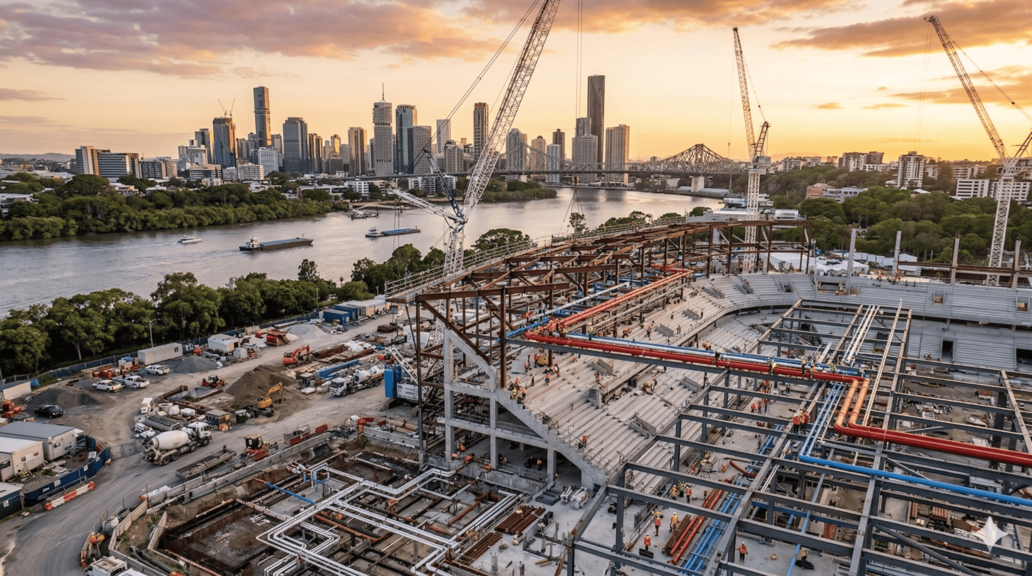
Gabba redevelopment and confirmed stadium projects require high-volume public amenity systems engineered for peak event load. Concourse drainage, plant room fitout, accessible facilities and commercial kitchen gas for hospitality concessions all sit within scope.
The compliance certification trail for stadium plumbing is more demanding than standard commercial work. QBCC inspection documentation, gas compliance certificates and fire system sign-off must survive the scrutiny of Games venue certification processes. Contractors without a documented compliance history on comparable projects will not clear procurement qualification.
Transport Hubs
Brisbane’s transport infrastructure investment includes station upgrades and new connections tied to the Olympic transport plan. Each upgrade triggers accessible amenity compliance under the Disability Discrimination Act and Queensland building codes. Drainage upgrades in older stations require asbestos-aware work practices and certification.
These projects are already in tender or early contractor engagement phases for some packages. The window here is not 2028. Parts of it are now.
Hospitality Venues
Queensland’s tourism accommodation and hospitality sector is investing ahead of 2032. Hotels, restaurants, function venues and short-stay accommodation upgrading for Games-era demand all trigger commercial gas compliance requirements. Type A gas certification for commercial kitchens is a recurring annual obligation, not a one-time project tick.
A contractor with established relationships across Brisbane’s hospitality sector before 2032 is a contractor with a built-in recurring revenue base during and after the Games. The procurement logic for hospitality operators favours contractors who already know their sites.
The Sydney 2000 Lesson: Positioning Is Not a 2031 Strategy
The 2000 Sydney Olympics created a contractor consolidation event that permanently reorganised the NSW commercial trades market. This is documented industry history, not speculation.
The contractors who captured the largest and most durable Olympic-linked work packages were not the most technically capable operators in Sydney at the time. They were the operators who had invested in Tier 1 builder relationships through the mid-to-late 1990s infrastructure build-out. When Olympic procurement opened, the qualification question was not who could do the work. It was who had the documented history to prove they already had.
Regional specialists who positioned early captured decade-long maintenance contracts after the Games closed. Those who waited for the tender announcements found the relationships already formed and the preferred supplier lists already closed.
The post-Games maintenance contract market is the revenue model most contractors do not price into their 2032 strategy. Athletes village becomes residential. Stadium precincts operate year-round. Transport hubs require ongoing compliance maintenance. The contractor embedded in these assets during construction is the contractor called when something fails at 2am in 2035.
Brisbane is not Sydney. The Queensland market is structurally different. The timeline is longer and the infrastructure programme is being delivered across a wider geography. Mackay, Gold Coast and Brisbane are all within scope. That geographic spread creates an opportunity for contractors with multi-location capability that did not exist in the concentrated Sydney delivery model.
QBCC Certification: The Hard Procurement Gate
QBCC Type A gas certification is not a competitive advantage in the 2032 procurement context. It is a baseline requirement. Contractors without it are excluded from relevant work packages before the evaluation stage begins.
The QBCC licence requirements for Olympic-linked commercial work extend beyond gas. Plumbing, drainage, roofing and fire protection work on venue and village projects will require licence coverage across multiple trade categories. Multi-trade contractors holding comprehensive QBCC coverage under a single entity reduce the contractor management burden for Tier 1 builders.
Licensed for plumbing, gas fitting and roofing. Operating since 1974. Three Queensland offices: Brisbane, Gold Coast, Mackay.
What Procurement Managers Are Actually Evaluating
Large infrastructure procurement teams are not reading trade profiles. They are running qualification assessments against defined criteria. The criteria for Olympic-linked commercial work will include:
- Current QBCC licence coverage across required trade categories
- Documented commercial project history at comparable scale
- Gas compliance certification records with evidence of certificate issuance
- Three-office or multi-location operational capability across Queensland
- Financial capacity and insurance coverage consistent with project scale
- Safety record and WorkSafe compliance history
Contractors who build this documentation profile through current commercial work are creating their 2032 qualification evidence now. The body of work needs to exist before the tender opens, not be assembled in response to it.
The SEO Play Nobody in Queensland Plumbing Has Made
Search volume for ‘commercial plumber Brisbane 2032’ is negligible today. It will not be negligible in 2027. The keyword cluster around Olympic infrastructure, Brisbane 2032 commercial construction, and QLD plumbing compliance for major events will compound toward the Games as developer and procurement searches intensify.
The contractor publishing authoritative content on this topic now is building topical authority in a keyword cluster with zero current competition and significant projected volume. A 2,500-word article published in 2025 with proper schema markup and internal linking accumulates six years of indexed authority before the peak search period arrives.
This is not a content marketing exercise. It is a six-year SEO compound interest position.
The Positioning Action Plan
Contractors serious about 2032 commercial work have a defined sequence of actions with measurable outcomes:
By End of 2025
- QBCC licence audit: confirm coverage across all relevant trade categories, identify and close any gaps
- Commercial project portfolio documentation: photograph, certify and record current commercial work at scale
- Tier 1 builder relationship mapping: identify the principal contractors delivering Brisbane 2032 infrastructure packages
- Compliance certificate systems: implement documented gas and plumbing compliance certificate management
2026
- Subcontractor registration with identified Tier 1 builders for relevant trade packages
- Prequalification documentation prepared and submitted to relevant procurement programmes
- First commercial site assessments for hospitality and accommodation sector clients targeting 2032 upgrades
2027–2029
- Active tendering on transport hub and venue precinct packages as they open
- Hospitality sector compliance contracts providing recurring revenue and site familiarity
- Post-Games maintenance contract negotiations for athletes village residential conversion
The contractors winning 2032 work are not going to show up in 2031. The procurement decisions are being shaped by relationships and qualification evidence being built right now.
Ready to position for 2032?
TRI Plumbing holds QBCC Licence 46389 covering plumbing, gas and roofing under a single contractor entity. Three offices across Brisbane, Gold Coast and Mackay. View our commercial capabilities.
Frequently Asked Questions
What QBCC licences are required for Brisbane 2032 commercial plumbing work?
QBCC certification requirements vary by project type. Gas work requires Type A gas licence certification. Venue and residential fitout requires Hydraulic Services (Plumbing and Drainage) licence coverage. Projects involving roofing require a separate roofing licence. Multi-trade contractors holding all three under one entity have a procurement advantage.
When do Brisbane 2032 infrastructure tenders open for subcontract packages?
Timeline varies by project. Transport infrastructure packages are in early procurement phases now. Athletes village construction tender packages are expected to open in 2026–2028. Stadium precinct works proceed under varied timelines. Monitor QBCC ProcureNet, the Queensland Government Procurement portal and Tier 1 builder prequalification programmes.
How did Sydney 2000 change the NSW commercial trades market?
The 2000 Sydney Olympics accelerated consolidation around certified, multi-trade contractors with Tier 1 builder relationships. Contractors positioned through the late 1990s captured the largest work packages and post-Games maintenance contracts generating a decade of recurring revenue.
What is the difference between Type A and Type B gas certification in Queensland?
Type A gas appliances are those not directly connected to a gas supply system in the way Type B appliances are. Commercial kitchen equipment is typically Type A and requires a specifically licensed contractor. Type B appliances, including most commercial boilers, require separate certification categories.
Does TRI Plumbing service all three Brisbane 2032 host cities?
TRI Plumbing operates from three Queensland offices: Brisbane, Gold Coast and Mackay. Brisbane and Gold Coast are primary Games host locations. All three offices operate under QBCC Licence 46389, providing consistent licence coverage across locations.